
 EN
 Turkish




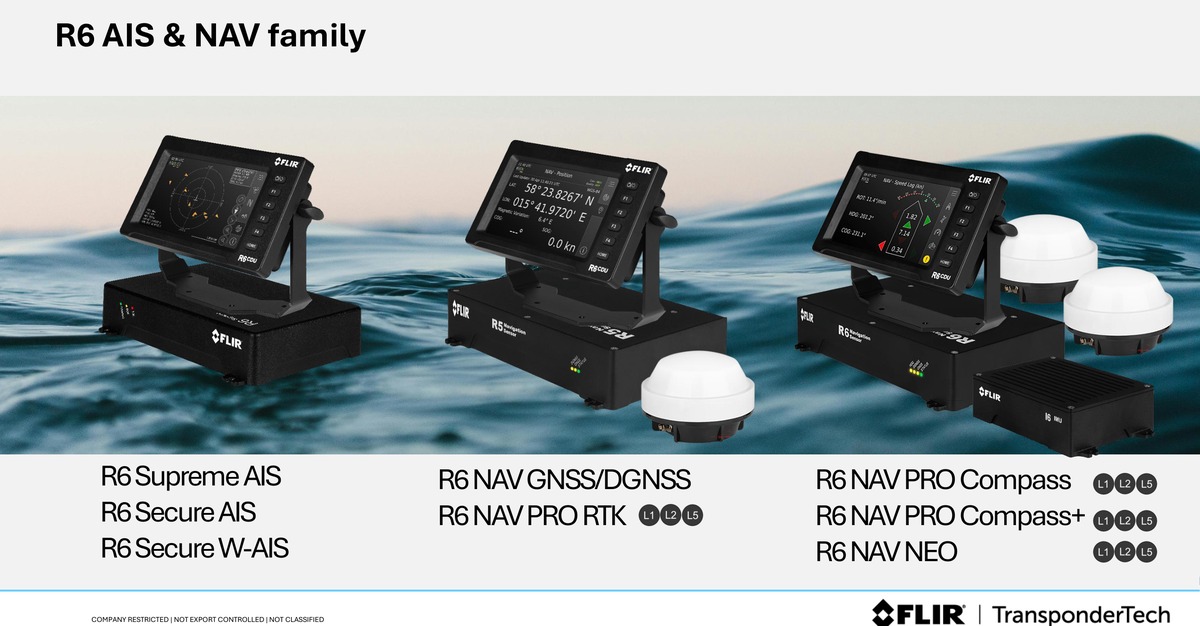
The maritime industry is undergoing one of the most critical operational transformations in its history. For over two decades, Saab TransponderTech has stood as the undisputed global gold standard in SOLAS Class-A AIS, DGNSS navigation, and coastal VDES networks. Now, having joined forces with electro-optical and advanced sensor leader FLIR (Teledyne Marine), this legacy enters a new era. The newly launched next-generation R6 product family not only elevates bridge ergonomics and processing performance, but also delivers a hardware-level, fully integrated defense shield against maritime cyber and hybrid threats: GNSS Jamming and GNSS Spoofing.
1. From Heritage to Innovation: Saab TransponderTech is Now FLIR
For deck officers, masters, and naval architects, the Saab R4 and R5 series have been synonymous with bulletproof reliability. Under the FLIR TransponderTech brand, this pedigree has been re-architected with cutting-edge processor power, responsive touch displays, and contemporary bridge network protocols.
Key highlights of the new R6 platform:
- Full Bridge Alert Management (BAM) Compliance: Seamless adherence to IMO MSC.302(87) and IEC 62923, drastically reducing bridge alarm fatigue.
- Modular Split Architecture: Transponder and Control and Display Units (CDU) can be installed flexibly across bridge consoles and wings with multi-display synchronization.
- Dual-Function 7" Touchscreen CDU: Operators can monitor and control both AIS transponders and GNSS/DGNSS navigation sensors from a single console.
- Military-Grade Cybersecurity & Encryption: Available R6 Secure and W-AIS configurations offer STANAG 4668 compliance and native Warship ECDIS (WECDIS) tactical integration.
2. Comprehensive FLIR R6 Product Portfolio
The R6 ecosystem spans commercial merchant shipping, offshore energy, and defense platforms:
| Model | System Type | Key Features & Certifications | Target Applications |
|---|---|---|---|
| R6 Supreme AIS | Class-A AIS Transponder | SOLAS certified, IEC 61993-2 Ed. 3, BAM compliant, 7" sunlight-readable touch CDU | Merchant vessels, tankers, container ships, passenger vessels, mega yachts |
| R6 Secure AIS / W-AIS | Tactical & Encrypted AIS | STANAG 4668 compliant, encrypted tactical link, WECDIS integration | Naval warships, Coast Guard cutters, law enforcement, border patrol |
| R6 NAV GNSS / DGNSS | Navigation Receiver | Multi-band (L1, L2, L5), multi-constellation (GPS, GLONASS, Galileo, BeiDou), IALA beacon receiver | Ocean transit, congested waterways, precise pilotage |
| R6 NAV PRO RTK | Centimeter-Level GNSS | RTK correction engine delivering centimeter-grade 3D positioning accuracy | Hydrographic survey, dredging, subsea cable laying, offshore construction |
| R6 NAV PRO Compass | GNSS Satellite Compass & SDME | Dual GNSS antenna heading (THD) and satellite speed log (SDME) certified | Magnetic/gyro compass backup, radar/autopilot heading and speed reference |
| R6 NAV PRO Compass+ | IMU-Assisted Hybrid Compass | Integrated I6 Inertial Measurement Unit (IMU) for continuous dead-reckoning heading during outages | Dynamic Positioning (DP), precision docking, tugboats, offshore support vessels |
3. Invisible Threats: The Rise of Maritime Jamming & Spoofing
Modern vessels rely entirely on satellite signals to feed autopilots, ECDIS, radars, AIS, and GMDSS. However, by the time GNSS radio waves travel 20,000 km to reach the ship's mast, their power drops to an extraordinarily faint -160 dBW. This makes satellite navigation uniquely vulnerable to terrestrial electronic disruption.
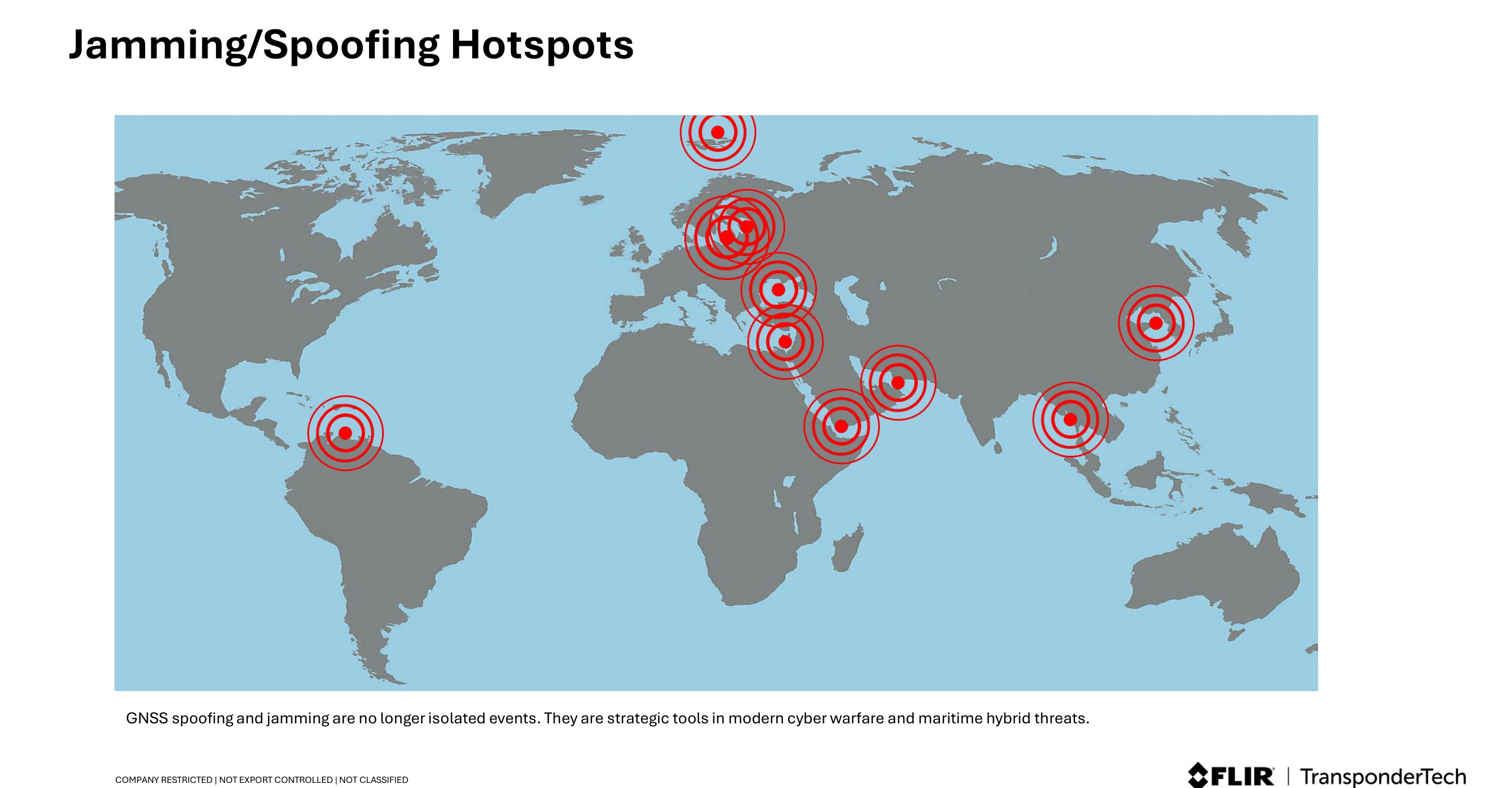
Figure 1: Active GNSS interference hotspots across the Black Sea, Eastern Mediterranean, Baltic, and Arabian Gulf
Jamming vs. Spoofing: Critical Distinctions
Mechanism: A high-powered transmitter drowns out legitimate GNSS frequencies (predominantly L1 at 1575.42 MHz) with overwhelming noise.
Bridge Symptom: The receiver loses carrier-to-noise ratio (C/N0), immediately triggering "Loss of Fix" or dead-reckoning alarms.
Operational Impact: Watchkeepers recognize the outage immediately and switch to radar/gyro visual navigation.
Mechanism: The attacker broadcasts fabricated yet mathematically valid satellite ephemeris signals with forged pseudoranges.
Bridge Symptom: The GPS display maintains a deceptive green "Fix OK" status while silently moving the ship's coordinates miles away or onto land.
Operational Impact: Catastrophic stealth hazard. Autopilots execute false corrections, driving vessels into mined zones, territorial disputes, or shallow banks.
4. Cascading Consequences Across Bridge Systems
When satellite positioning is degraded or spoofed, the failure cascades throughout the integrated navigation bridge:
- ECDIS: Displayed own-ship contours and safety depth vector calculations become invalid, increasing grounding risks.
- AIS: The vessel broadcasts falsified telemetry to surrounding traffic and VTS centers, disrupting regional situational awareness.
- ARPA & Radar: True motion vectors collapse, creating false collision warnings and miscalculating CPA/TCPA under COLREG rules.
- Autopilot & Dynamic Positioning (DP): Sudden spatial position jumps cause automated helms to apply aggressive rudder corrections.
- GMDSS & VHF-DSC: Automated distress transmissions broadcast invalid coordinates to search-and-rescue centers.
5. FLIR R6 Multi-Layered Defense Architecture
FLIR TransponderTech addresses electronic warfare threats through hardware-level resilience mechanisms built directly into the receiver core:
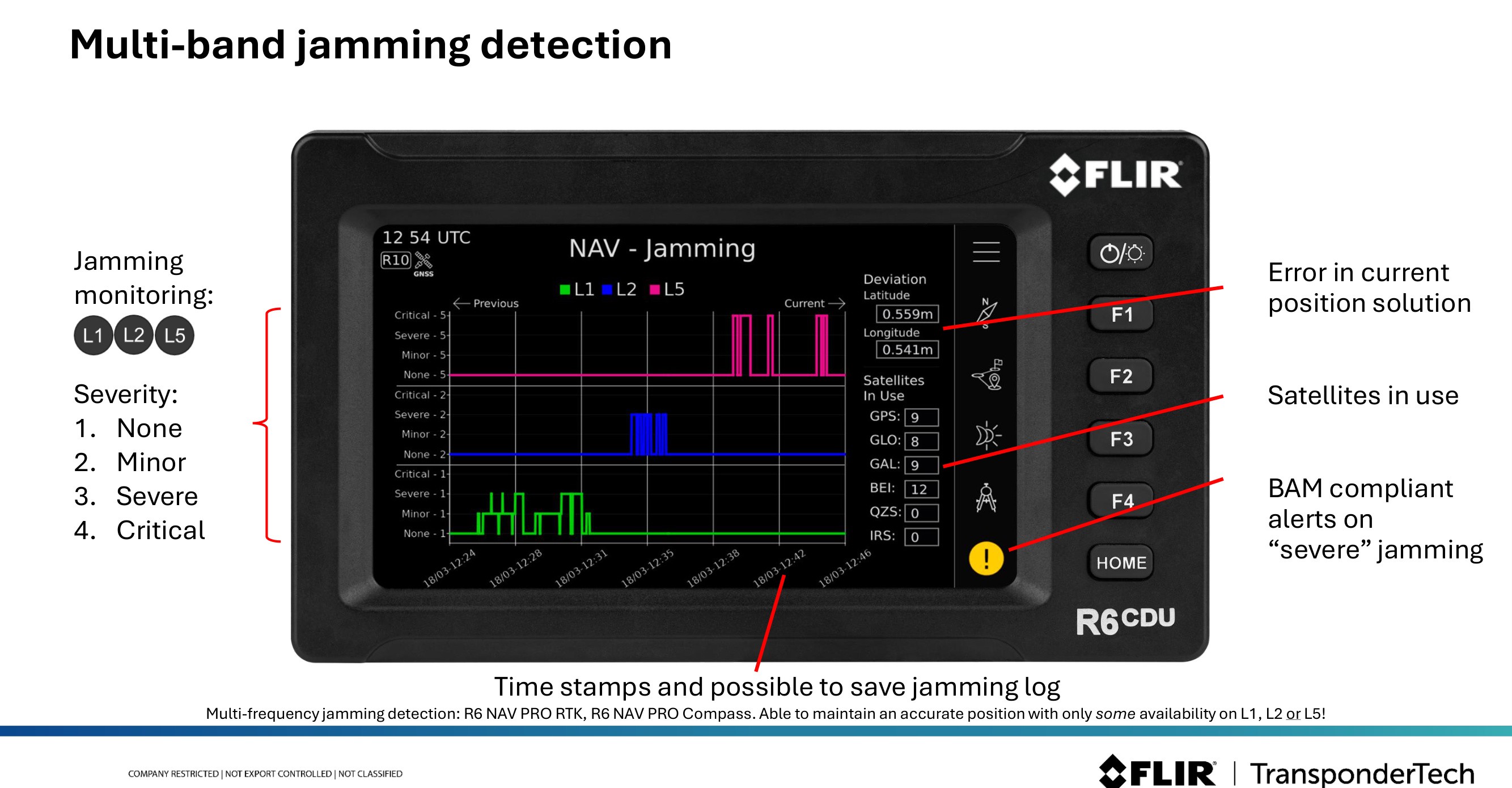
Figure 2: Real-time C/N0 spectral monitoring and multi-frequency jamming detection on the FLIR R6 CDU
A. Multi-Band & Multi-Constellation Agility
Legacy marine GPS systems operate exclusively on a single frequency (GPS L1: 1575.42 MHz). Modern jammers easily saturate this narrow band. The FLIR R6 NAV platform tracks GPS, Galileo, GLONASS, and BeiDou simultaneously across the L1, L2, and L5 frequency bands. If L1 is jammed, the system autonomously transitions to L2/L5 signals without losing positioning continuity.
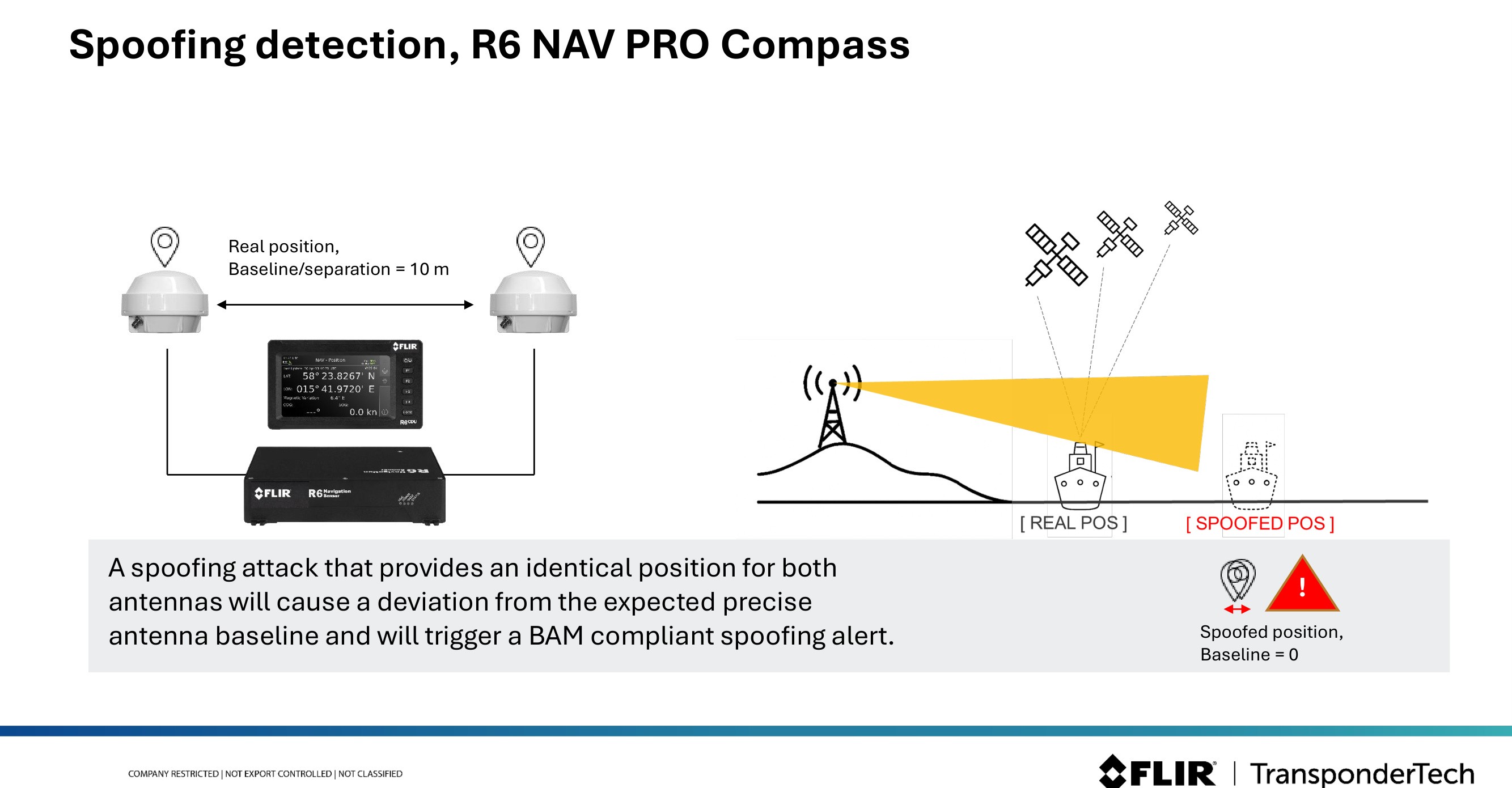
Figure 3: R6 NAV PRO Compass: Instant spoofing detection via dual-antenna fixed spatial baseline verification
B. Dual-Antenna Baseline Spoofing Detection (R6 NAV PRO Compass)
Unlike genuine satellites orbiting across diverse azimuths and elevations, spoofing attacks originate from a single terrestrial or airborne emitter. The FLIR R6 NAV PRO Compass continuously measures the phase relationship and fixed distance (baseline) between its two mounted antennas. Because forged signals strike both antennas from the exact same single arrival angle, the R6 processor instantly flags the geometric anomaly, triggers a "Spoofing Detected" BAM alert, and blocks corrupted data from polluting bridge systems.
6. Antenna Defense: Passive LEANA vs. Active CRPA
The antenna is the first physical barrier against RF jamming. Conventional omni-directional domes absorb hostile noise indiscriminately. FLIR offers two advanced anti-jamming antenna solutions:
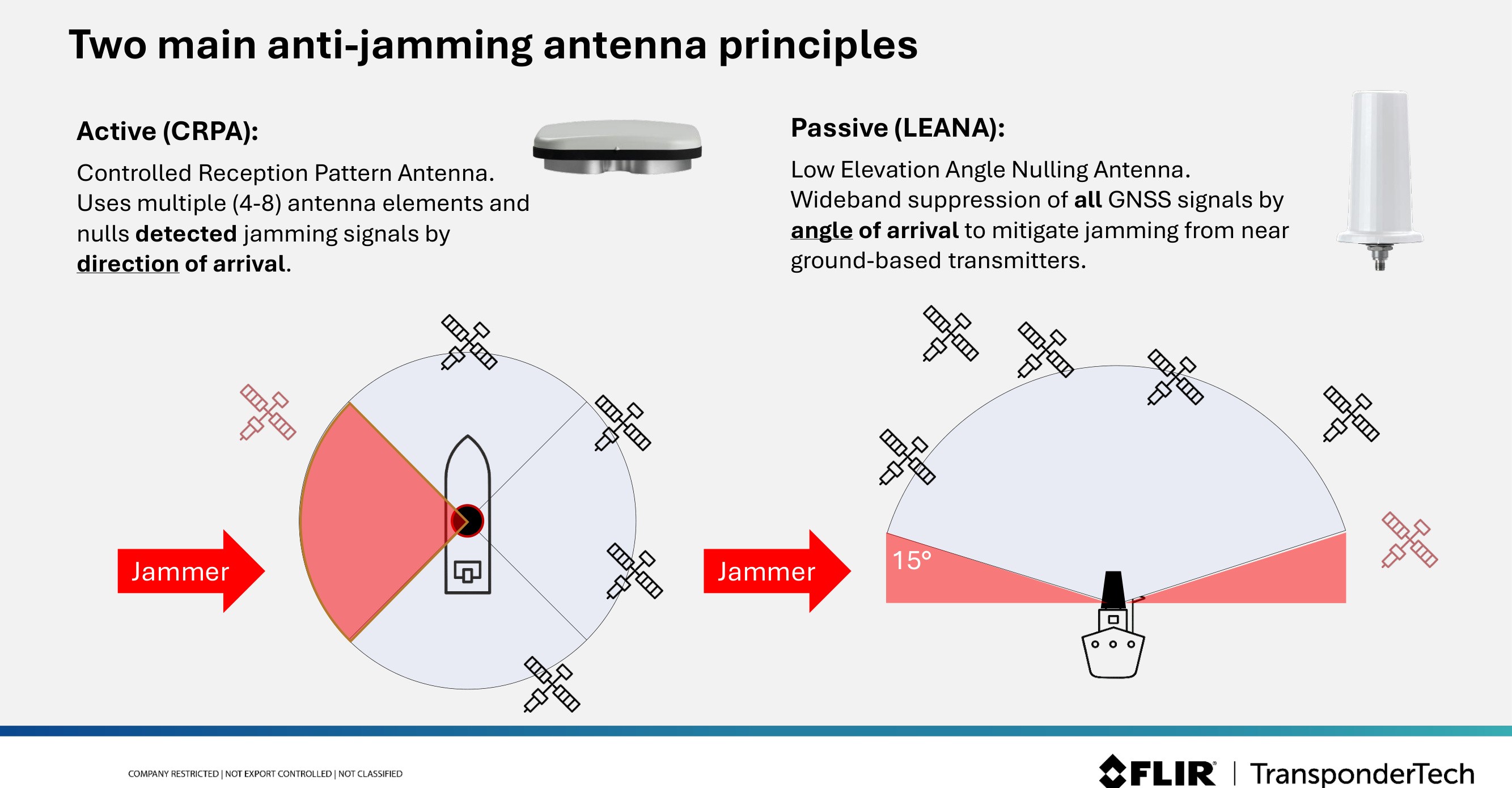
Figure 4: Passive LEANA horizon nulling vs. Active CRPA dynamic null-steering antenna architectures
| Parameter | Passive LEANA Antenna | Active CRPA Antenna |
|---|---|---|
| Operating Principle | Low Elevation Angle Nulling (LEANA) shaping antenna gain pattern | Controlled Reception Pattern Antenna with multi-element digital null-steering |
| Jammer Suppression | Attenuates terrestrial horizon interference by ~20 dB | Dynamically steers deep spatial nulls toward jammers for >40 dB suppression |
| Power Requirements | 100% Passive (Requires no external power or processor unit) | Active multi-channel RF processing and dedicated power supply |
| Multi-Jammer Handling | Suppresses general horizon-level interference | Neutralizes multiple simultaneous jammers from distinct directions |
| Ideal Use Case | Merchant fleets, retrofit installations, cost-effective defense | Naval vessels, Coast Guard, high-value assets, extreme contested waters |
7. Conclusion & IRMARINETECH Engineering Solutions
In contested waters, cyber and electronic warfare threats are no longer hypothetical. The fusion of Saab TransponderTech's uncompromising engineering and FLIR's defense expertise in the R6 series provides mariners with unmatched situational certainty.
Bridge Modernization with IRMARINETECH
IRMARINETECH provides comprehensive turnkey procurement, bridge engineering, Class-approved installation, and ECDIS/BAM integration for the entire FLIR TransponderTech suite:
- Direct plug-and-play retrofit kits from existing Saab R4/R5 units to the next-gen R6 series with zero structural re-cabling
- Custom LEANA and CRPA anti-jamming antenna deployments for vessels operating in the Black Sea and Eastern Mediterranean
- 24/7 global field support, system commissioning, firmware management, and genuine spare parts
To consult with our marine electronics engineers and explore the optimal FLIR R6 configuration for your fleet, please contact our technical sales team.
 (1).png)
.png)
.png)